
How AI Is Changing Online Exams in 2026
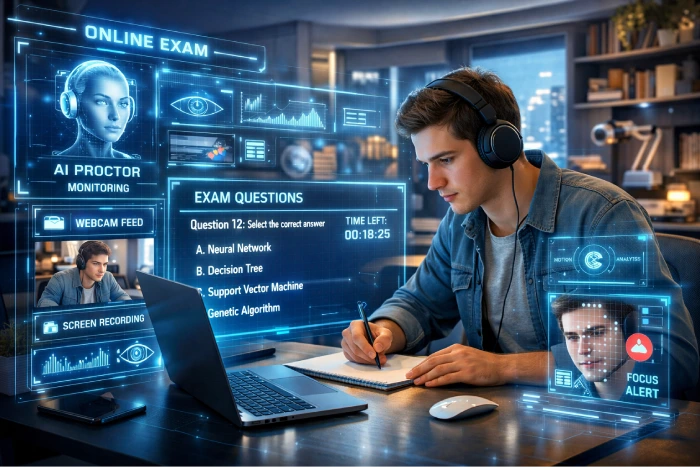
In three ways, AI has transformed ai online exams: monitoring, question generation and evaluation. These changes are more apparent in online exams in 2026, where institutions are transcending the use of basic remote supervision. This guide provides information on how online exams work, where their boundaries lie, and what you can look forward to if you are taking a test.
What Actually Changed: Three Shifts at Once
There are three primary areas of the biggest changes.
- Monitoring: AI systems can aid or even automate some aspects of invigilation, detecting odd behaviours.
- Question creation – AI can be used to create a bigger question bank and to facilitate adaptive assessments.
- Grading: Automated systems are able to grade more than multiple-choice responses, such as written and other digital responses.
These changes have combined to make AI online exams more complicated. Institutions are leveraging AI to develop assessments and ensuring the assessments are not misused.
This transformation reflects the broader trend of the increasing adoption of AI in education assessment, where automation has become a more integral part of the assessment process.
Shift 1 — How Online Exams Are Monitored
Several different models of proctoring can be used with online assessments:
- Supervised online: The session is supervised in real time by a human.
- Recorded proctoring: This is a session that will be recorded for later review.
- Automated proctoring: Software recognises potentially unusual activity.
- Hybrid proctoring: Using AI to identify activity and human review of selected cases.
Nowadays, modern AI proctoring software systems can track multiple signals simultaneously.
| Technique | What it monitors |
| Identity verification | Face and identity matching |
| Gaze tracking | Head and eye movement |
| Audio analysis | Voices and unusual sounds |
| Keystroke analysis | Typing patterns |
| Secure browsers | Restricted applications and websites |
| Screen monitoring | On-screen activity |
| Device detection | Possible secondary devices |
| Location checks | IP or location information |
The intent of using a remote proctoring technology is to ensure that a record is made of the testing environment and that the activity that needs to be reviewed is identified.
The other type of remote proctoring technology is a combination of multiple signals instead of one single signal. This has grown in importance in the era of impersonation, deepfakes and continually more complex identity issues.
Knowing how AI detects cheating doesn’t imply that all flags are indicative of cheating. These systems can detect patterns or anomalies which might need further evaluation.
As a general explanation, the technology behind remote exam surveillance can give background information on the systems used.
What a proctored online exam involves is simply that you will be supervised by a proctor throughout the entire exam process. What a proctored online exam is: a proctor supervises you throughout the exam process.
Shift 2 — How Exam Questions Are Built
Exam providers can have much bigger question banks when using AI for item generation. This can minimise the amount of repetition of questions among candidates and among attempts.
Larger banks are also more likely to be able to make adaptive testing more practical for online exams in 2026. The difficulty can be varied based on the responses from the previous questions, so that two candidates could be given different questions.
AI can also be used to analyse the performance of items. Questions that are easy, too difficult or not clear can be identified more quickly and reviewed.
This is another instance of how the design of tests is being transformed by the use of AI in education assessment instead of merely being supervised.
Students who wish to delve into preparation may also examine how students score consistently higher on exams for a wider range of studies.
Shift 3 — How Exams Are Graded
Now automated marking is more than just multiple-choice questions. Essay and code submissions, as well as audio responses and other digital submissions, are supported by current systems.
This can enable institutions to implement assessment formats which used to take a significant amount of marking time. Rushed processing can also result in more rapid feedback, which can be more than just a score, but also include diagnostic information.
Automation doesn’t mean taking humans out of the mix, though. In cases of appeal, unusual answers and close calls, human review may still be performed in cases of high stakes.
While the development of AI online exams goes on, the difference between automated marking and human marks is still vital. Similarly, AI proctoring works similarly, with automated detection potentially triggering human review of the content, not automatically marking it as a violation.
The Problems AI Hasn’t Solved
While AI has enhanced the technology of assessment, there are still several issues that must be addressed.
- False flags: When a person is not looking, lighting is poor, there is movement, or there is a problem with the connection, it can raise suspicions but not lead to an accusation of misconduct.
- Accessibility and bias: Facial and gaze-based systems can be different for different people and in different situations. Alternatives must be provided for students who make accommodation requests.
- Privacy: Video, biometric data and network data may be used for proctoring. Each provider may have their own retention policy.
- Accountability: Students may not always know how a decision has been taken, or how they can challenge a decision.
- The arms race: increased detection increases the likelihood of new ways of evading controls – should assessment design change?
These are some of the key factors that will be discussed when it comes to AI proctoring and remote proctoring technology. It can be used to promote academic integrity, but its accuracy, fairness and data practices have yet to be examined.
The psychology of test anxiety is also important in the broader context, as anxiety can impact students’ experiences of highly monitored assessments.
What This Means for You as a Test-Taker
It’s not necessary to anticipate each technological shift. Rather, it is important to concentrate on what your institution needs before AI online exams.
- Read the monitoring policy before test day.
- Fill in the provider’s system check.
- Set up testing area as specified.
- Become familiar with the appeals process BEFORE you have to use it!
- Do not use “recall only” questions; prepare concepts.
- Make inquiries about accommodations as early as possible.
Understanding how AI detects cheating can also be useful to understanding why normal room conditions, identity checks and technical problems can be relevant for an assessment.
How to prepare your room for a proctored exam provides practical tips on setting up your room when you’re not sure how to do it. It is also helpful to understand what to expect during your first remote proctored exam.
Frequently Asked Questions
- Do all online exams use AI proctoring now?
No. There are various blends of live invigilation, recorded invigilation, automated invigilation and traditional assessment techniques used by institutions.
- Can AI proctoring flag me for something innocent?
Yes. Only activity that is flagged constitutes a flag for review.
- Does AI grade my exam or does a human?
It varies with the determination. There may be automated systems which can mark routine responses and human marking for complex or disputed responses.
- Is AI proctoring legal?
Legality is dependent on jurisdiction, institutional policy and relevant privacy/bio data laws.
- Will online exams keep using this much surveillance?
The future of online examsis unclear. Institutions can still use monitoring, although there is potential for privacy, accessibility and assessment-design issues to impact the extent of monitoring used. For more information, read online exam rules to know before test day.
Conclusion + CTA
While the future of online exams will be further defined by the use of AI, there will also be a need for fairness, transparency and human judgement in effective assessment.