
CompTIA Exam Objectives vs Practice Questions: How to Find Knowledge Gaps
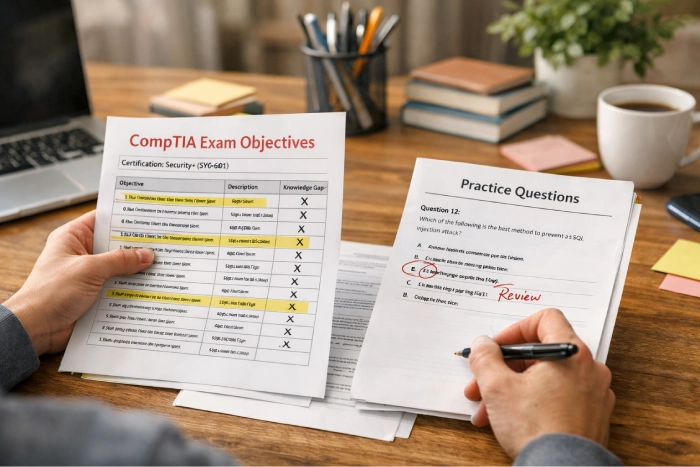
The CompTIA exam objectives document is the official blueprint for what an exam can test; practice questions reveal which topics you have not mastered and need improvement. Use the objectives as your map and a practice test as your measurement. However, a raw practice score does not show exactly where your knowledge gaps lie, and domain weighting makes that distinction important.
Instead of repeating random questions, focus on each and every practice test to calculate domain-level performance that can improve your readiness. This method turns every session into a focused and measurable study plan with the help of objectives and practice questions, before spending another hour on familiar material.
What the Exam Objectives Document Actually Is?
The official blueprint is a checklist, not a textbook. CompTIA publishes a free PDF file for each exam code that lists the domains, each domain’s percentage, numbered objectives, and sub-bullets that describe the knowledge and skills that are tested. Use the blueprint to track your progress when reading and practicing each of the required skills. The exam objectives are more reliable than a study guide because they define the scope of your test.
The SY0-701 exam has a total of 28 objectives divided into five domains, compared to 35 objectives and six domains for SY0-601. In particular, the old standalone Implementation domain was folded into the Security Architecture and Security Operations areas. Studying an old outline will make you study an incorrect structure. So download the relevant PDF file of CompTIA exam objectives for the exam code you are going to take before you start preparing by reading, attending classes, or practicing with a sample practice test.
Security+ SY0-701 Domain Weights
The official Security+ blueprint gives different weights to different areas. The following table lists the domains along with their weights and the corresponding number of questions for a 90-minute exam with 90 questions and PBQs.
| Domain | Weight | Approx. questions of 90 |
| Security Operations | 28% | ~25 |
| Threats, Vulnerabilities & Mitigations | 22% | ~20 |
| Security Program Management & Oversight | 20% | ~18 |
| Security Architecture | 18% | ~16 |
| General Security Concepts | 12% | ~11 |
SY0-701 has a maximum of 90 questions that must be answered correctly in 90 minutes for the 90-minute exam, which includes a mix of domains of multiple choice questions and PBQs. The passing score for this exam is 750, a scaled score, not a percentile. Preparation time for Security+ should be focused towards those areas that have been allocated higher weights.
Practice makes perfect, and you will need plenty of it to master Security Operations since many of the tasks are scenario-based and require you to perform a variety of skills. Although the domains are not interchangeable, a poor performance in the largest area may have a more significant impact than the same rank in the smallest one.
Why a Raw Practice Score Hides the Gap?
A single practice test score can create a false sense of security as it can hide a critical weakness or even knowledge gaps, as well. Consider this sample result.
| Domain | Weight | Score | Weighted Contribution |
| General Security Concepts | 12% | 90% | 10.8 |
| Threats, Vulnerabilities and Mitigations | 22% | 80% | 17.6 |
| Security Architecture | 18% | 70% | 12.6 |
| Security Operations | 28% | 55% | 15.4 |
| Program Management | 20% | 75% | 15.0 |
| Weighed Total | 100% | 71.4% |
The unweighted average is 74.0%, while the weighted result is 71.4%. The raw average is overstated by 2.6 points since the lowest score is in Security Operations, which is the highest weighted domain. One might look at an aggregate score of the practice test and be misled into believing that they are confident in their ability in one of the areas when, in fact, they are not. It is important to review each domain and compare it to the weighted average to identify knowledge gaps.
The Objective-Mapping Gap Log
By seeing the following table, instead of stating a general topic, for example, “security,” match the question to the numbered objective weight, cause and action found in the official PDF.
| # | Question | Domain | Objective | Weight | Cause | Action |
| 1 | Firewall rule ordering | 3 Security Architecture | 3.2 | 18% | Didn’t know secure protocol placement | Re-read objective 3.2, then 10 targeted questions |
| 2 | SIEM alert triage | 4 Security Operations | 4.3 | 28% | Knew the term, couldn’t apply it | Practise log analysis scenarios |
Follow this method:
- For each missed question and guess that you got right, note the domains and objective numbers.
- Go to the PDF, locate and check off the sub-bullet you need to focus on for that objective.
- It is best that you classify what the reason for your mistake was: missed knowledge, misread question, hard question to understand, knowledge gaps, or just did not have time to answer.
Re-test that objective again in the next 48 hours using full length practice test. You should also note the practice questions you guessed correctly as well. You may think you know more than you actually do. Getting a lot of questions wrong on one objective means you should probably review that objective more closely. If you got a lot of questions wrong across many exams objectives, that means reviewing your basics would be a good idea.
Where Your Study Hours Actually Pay?
The weighted calculation also shows you which areas are most worthy of adding an extra hour of study. Raising Security Operations by ten percentage points improves the outcome by 2.8 points, as its weight is 28%. The same applies to General Security Concepts by 12% and 1.2 points. However, the same 10 percentage point raise applied to Domain 4 will improve the outcome by 2.3x.
Once you identified the baseline, focus your next study block on the area with the lowest percentage that is substantially weighted. Avoid investing time in the domain that seems the easiest for you, this will not help you overcome your knowledge gaps. A 90% result in a domain is less valuable than repairing a 55% result in Security Operations. For the Security+, think of the SY0-701 percentages in terms of value and apply your hours according to the most needed improvements. The point is not to avoid lighter domains but to prioritize heavier ones.
What Practice Questions Can’t Simulate?
Practice questions are indeed helpful, but they only serve as a diagnostic tool– they cannot fully replicate the real exam. Performance-based questions (PBQs) include tasks that require configuration, troubleshooting, and/or analysis, so you should prepare PBQ-specific practice tests separately. The CompTIA exam also tends to use certain phrasings, so it may be helpful to take a practice test that more closely resembles the real thing rather than a generic test bank.
The passing score for the Security+ is 750 on a scale from 100-900, which does not mean 83% – remember that it is a scaled score, so it does not directly reflect the percentage of correct answers.
Finally, memorizing answers is an ineffective strategy, since the same objective can be presented in multiple ways. You should review networking fundamentals and take a free CompTIA Network+ practice test, but focus on Security+ preparation.
Frequently Asked Questions
Where do I get the official CompTIA exam objectives?
Download the CompTIA exam objectives PDF for your exam code; take care to choose the right code, SY0-701, since this one is different from SY0-601, which has six domains and 35 objectives.
What practice score means I’m ready for Security+?
Don’t focus on an overall weighted domain score; look instead at individual scores for two or three timed practice tests and aim for consistency in your results. Practice performance-based questions separately since your score on multiple-choice questions isn’t necessarily an indicator of your test-readiness.
How many domains are on SY0-701?
Security Operations (28%), Threats and Mitigations (22%), Program Management (20%), Architecture (18%), and General Security Concepts (12%) are the five main domains on SY0-701.
Conclusion
Use the CompTIA exam objectives as your guide, practice questions as your compass, and weighting as your measuring tape. Identify and monitor knowledge gaps, and retest and prepare accordingly. Regularly review, practice, and repeat weekly. In cases where additional support for understanding exam objectives is required, you may opt to take my CompTIA exam for me.