
Certification Exam Experience Requirements: Why They Matter Before You Register
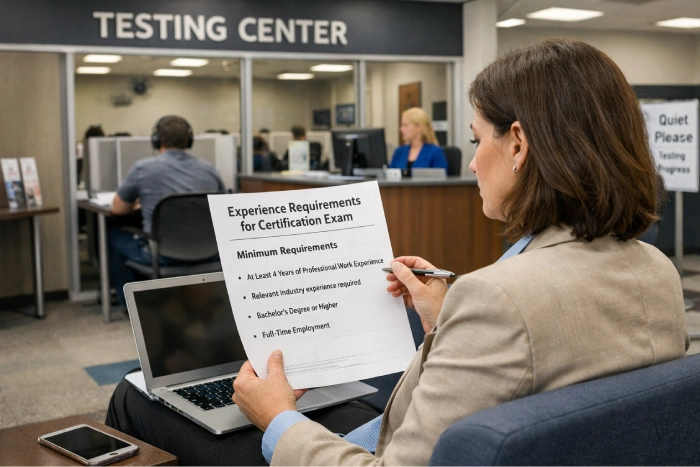
Before registering for a professional certification, certification experience requirements almost never prevent a candidate from taking the examination; they do prevent one from being issued the certification. The two-stage system creates an error for candidates who confuse the right to take the test with the right to be certified.
Checking an experience requirement before paying will help you avoid expiration of test results, additional maintenance fees, and difficulties proving eligibility. Before spending hundreds of dollars, understand how each body uses a different model and how those differences affect your next step this month. Some candidates can register immediately, while others should check their experience, deadlines, and documentation.
Two Gates, Not One
There are two g certification gates. Understanding them saves time and money.
Gate 1 — Can you take the exam?
Usually, yes. Many certification bodies allow candidates to sit an exam before gaining the required professional experience, then require that experience before awarding the credential. However, rules vary by certification. Understanding the difference between exam eligibility and certification eligibility helps you avoid unnecessary delays, missed deadlines, and registration costs.
Gate 2 — Can you keep the certification?
Work experience matters here. Some organizations have an experience requirement before awarding certification, while others allow candidates to qualify later. Passing too early may result in an expiring result and annual maintenance fees. Four models determine certification experience requirements.
- Mandatory-with-waiver (CISM): You should have the relevant management experience; however, some approved education or credentials may waive the requirement.
- Mandatory-with-deferral (CISSP): You may take the exam before having enough work experience according to the Associate pathway and deadline.
- Structured hours (PMP): You should satisfy project experience and education requirements before applying.
- Recommended only (CompTIA):Certification experience requirements may be recommended in some cases, but they are not mandatory.
These certification experience requirements help you make your decision about signing up now, waiting, or taking the test prior to certification.
Side-by-Side Comparison
Requirements for certification differ in terms of experience required, available waiver or exemptions, and the deadline. Here is a table that helps you compare the four certification schemes before making any payment for the registration fees.
| Certification | Experience required | Maximum waiver | Can you sit first? | Window to claim |
| CISM | 5 years in information security management across 3 of 4 domains | Up to 2 years | Yes | 5 years from passing |
| CISSP | 5 years of paid experience across 2 or more of 8 domains | 1 year | Yes, as an Associate of ISC2 | 6 years |
| PMP | 36 months with a four-year degree; 60 months with a secondary diploma | None | No; eligibility is required when applying | Not applicable |
| CompTIA Security+ | No formal experience requirement | Not applicable | Yes | Not applicable |
Important accuracy note: Current guidance of PMI 2026 guidance also includes a 24-month experience pathway for eligible graduates of PMI Global Accreditation Center (GAC) programs. The PMP row should include this exception before publication.
CISM — Mandatory with a Waiver
CISM requires five years of information security management experience across at least three of its four domains. Up to two years can be waived for qualifying education or credentials, but management-level experience remains essential. This experience requirement must be met using experience gained within the ten years preceding the application. Candidates can sit the CISM exam first and have five years from passing to apply for certification.
Before registering, review your responsibilities and confirm that they demonstrate information security management rather than technical work alone. Keep employment dates, job descriptions, project records, and evidence of your duties so you can support your application. Check the current ISACA experience requirement and waiver rules before relying on a qualification to reduce the required experience. Meeting the exam requirement does not automatically guarantee certification.
CISSP — Mandatory with a Deferral
CISSP requires five years of cumulative paid work experience across at least two of its eight Common Body of Knowledge (CBK) domains. A qualifying four-year degree or approved credential can reduce the experience requirement by one year. This reduction does not stack, so holding multiple qualifying credentials does not increase the maximum waiver beyond one year.
Critical two critical points:
Associate of ISC2 Program: Take the exam and pass CISSP, then become an Associate of ISC2. In this way, you will get six years to achieve the required experience. It is just a deferral, not a waiver.
Waiver List Change in April 2026: Effective 1 April 2026, ISC2 reportedly reduced its approved CISSP experience-waiver list from around 50 credentials to 25. Reported removals include CEH, CISA, CRISC and OSCP. Check ISC2’s current official list before relying on a credential to reduce your experience requirement, as outdated information can lead to incorrect eligibility planning.
It is recommended that you consult the list before taking any action.
ISC2 also recognizes qualifying unpaid internships.
PMP and CompTIA — Two Different Answers
PMP: Structured experience and education
PMP applicants generally need 36 months of project management experience with a four-year degree or 60 months with a high school diploma, plus 35 contact hours of project management education. Eligible graduates of PMI Global Accreditation Center-accredited programs may qualify through a 24-month experience pathway. PMP applicants must meet the applicable experience requirements when applying.
PMI may audit applications, so candidates should maintain accurate experience and education records.
CompTIA: Recommended experience without being mandatory
CompTIA Security+ has no formal work experience requirement, so candidates can pursue the certification without previous IT employment. However, CompTIA recommends Network+ knowledge and around two years of IT experience with a security focus. These recommendations can help candidates prepare, but they are not mandatory eligibility conditions for taking the Security+ exam.
What Actually Gets Verified?
Before applying for a professional credential, remember that experience requirement depends on your duties, not your position. The certifying body evaluates what you do. For instance, a security analyst responsible for a risk or security management program qualifies, but a manager without responsibility for an information security management program does not.
Always document your work experience from day one. List employers, employment periods, job responsibilities, projects worked on, domains, and verification of your duties.
Applications can be audited, so provide accurate information and keep the necessary documentation. Exaggerating responsibilities or claiming non-existent experience jeopardizes your certification.
Understanding certification experience requirements helps you identify shortcomings and gather the necessary documentation.
Should You Register Now, Wait, or Take the Exam First?
- Register now: You meet the exam requirements and can plan for any remaining experience requirements.
- Wait: You are not eligible or cannot meet the experience deadline.
- Take the exam first: Choose this only if the certifying body allows it. CISM gives you five years after passing, while the ISC2 Associate pathway allows six years. PMP requires eligibility when you apply.
How Long Do You Have to Complete Certification Experience?
The deadline for completing certification experience depends on the certifying body. CISM candidates have five years after passing the exam to apply for certification, while ISC2 Associates have six years to meet the CISSP experience requirement. PMP applicants must meet the applicable experience and education criteria when submitting their application.
Always verify current rules and document your experience from day one.
Frequently Asked Questions
Can I register for a certification exam without the experience?
Usually, yes. Certification experience requirements often separate sitting the exam from receiving the credential. You can pass first, then complete the required experience within the allowed timeframe to qualify.
Do waivers stack if I have a degree and a certification?
For CISSP, no. The maximum waiver is one year, regardless of your qualifications. CISM allows up to two years. Always plan within the stated maximum.
What happens if I pass but never meet the experience requirement?
You hold a passing result, not the credential. CISM gives you five years from passing; an Associate of ISC2 has six years. Missing the deadline can prevent certification.
Does CompTIA Security+ require work experience?
No formal requirement exists. CompTIA recommends around two years of IT experience with a security focus and Network+ first, but structured self-study can also prepare candidates for the exam.
Conclusion
Check which model applies to your certification experience requirements before paying. Confirm the current experience requirement with the issuing body, whether you choose CISM or PMP. Need help preparing? Explore our CISM exam support and plan your next step confidently.