
The Future of Remote Assessment Beyond Traditional Exams
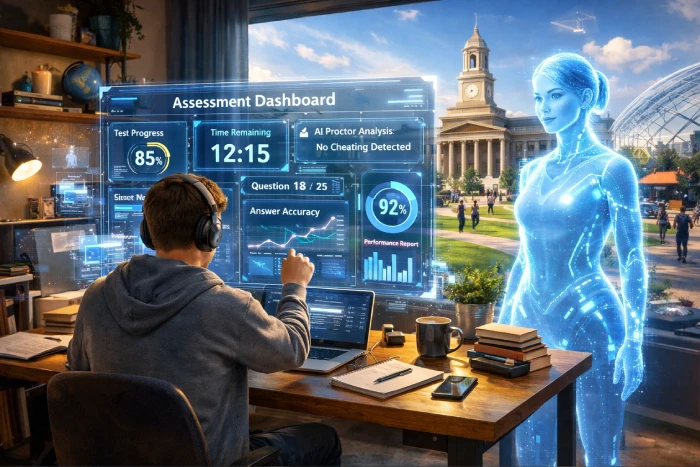
The future of remote assessment isn’t the end of exams. It is a division into two separate roles: high-stakes, identity-verified testing, and ongoing evidence of learning. Take-home written work is difficult to verify with generative AI, making it increasingly challenging for institutions to determine what it measures. This blog looks at the alternatives to traditional exams that are available and where the exam is still valid. For background on the current baseline, see how online exams work today.
Why Traditional Exams Came Under Pressure
The traditional model of exams came under pressure from four forces.
- Verification collapsed for unsupervised written work. With the widespread accessibility of generative AI, essays and take-home assignments no longer make for reliable online assessment methods to determine individual ability.
- Recall-based testing measures the wrong thing. Testing retrieval has less value than testing judgement and application, which is an important argument for authentic assessment, if information is easily retrieved.
- Timed exams have poor authenticity. There is hardly ever professional work that can take place for more than 90 minutes in a silent room without resources.
- Surveillance has limits. Increased monitoring introduces privacy, equity, and cost concerns, and scientists are more and more advocating for improved assessment design as a solution instead of increased observation, one of the clearest motivators for the shift to alternatives to traditional exams.
The Split: Verification vs Evidence
Assessment is splitting into two distinct jobs.
- Verification: establishes that something (such as a person) is capable of doing a particular thing in a given situation. This is where proctored, verified exams are still tougher. The status of “licensure, certification, and admissions” is well entrenched.
- Evidence: constructs a picture of learning over time by way of work products, iterations, conversations, and demonstrations. Portfolios, projects, and continuous assessment play a role in the future of remote assessment.
Most programmes will be offered in both. The error is that one is replacing the other. What really happens is that the exam is no longer the only source of truth; it’s rather one checkpoint in a series of checkpoints. To see how this plays out in practice, review what a proctored online exam involves.
Six Formats Replacing or Joining the Exam
| Format | What it measures | Where it’s being used |
| Oral exams and vivas (remote) | Whether you can explain and defend your reasoning in real time | Postgraduate work, medicine, law |
| Portfolios and process evidence | The work and its history: drafts, versions, revisions, trials | Programme design, computing and writing programmes |
| Authentic performance tasks | Realistic business situation and realistic outcome | Case analysis, care plans, simulations |
| Competency-based assessment and micro-credentials | Performance linked to specific and measurable skills instead of a single grade | Vocational and professional training is provided. |
| Adaptive continuous assessment | Regular low-stakes assessment that is flexible to the learner | Replacing one-off high-stakes snapshots |
| Conversation-based and reflective assessment | Reflective documents with references to placements or personal experience | Hard to generate generically |
These online assessment methods sacrifice efficiency for validity. They require greater staff time per student, and this is the primary reason for the unevenness of adoption. Highly resourced programmes are more likely to experiment with new forms, whereas others may stick to traditional programmes simply because they do not have sufficient resources to change them.
Competency-based assessment is emerging as a popular choice as it aligns directly with the expectations of the employer, and not an abstract grade. To get an idea of the stringency of some of the current formats, check out the hardest professional certification exams.
Where Timed Exams Still Win
Exams remain the right tool in specific conditions:
- The stakes are public safety, and an individual needs to be certified by a licensing body in nursing, medicine, law, aviation, or engineering.
- There needs to be comparability among thousands of candidates, as with admissions testing.
- The skill is really recall and rapid judgement under pressure, which is what clinical decision-making is in reality, and what critics will not credit.
- The risk that this fraud poses is so significant that it is imperative that identity verification is performed.
This is why professional licensure exams have become more secure, and not less, even while the assessment of coursework has been diversified in other ways. Thefuture of remote assessment does not imply a uniform change; rather, different sectors are moving at different speeds. To understand how remote proctoring detects cheating, check out how remote proctoring works to detect cheating. None of this is an argument for alternatives to traditional exams everywhere.
What This Means for Licensure and Certification
The formal exam is most important to licensing bodies if they wish to keep it going because it’s the employers’ trust in the credential that makes it valuable.
The future of remote assessment 2026 is not that we will be doing fewer exams, but that we will be doing more layers of verification, such as identity checks throughout the session, bigger adaptive item libraries, and performance- or simulation-based elements added to the multiple-choice core.
Even in the context of licensure, some fields are beginning to incorporate a component that is more practical or simulation-based than written, and so are moving toward competency-based assessment.
The practical lesson for students in nursing, allied health, law, or accounting: the exam is likely to remain in place; it will be made more secure, and more of your programme grade will be derived from alternatives to traditional exams that are embedded within ongoing coursework. For subject-specific detail, see what the TEAS exam actually tests and what the LSAT involves.
How to Prepare for a Changing Assessment Landscape
- Build explainability: In an oral or viva format, you won’t be exposed if you cannot explain your reasoning aloud. Practise explaining your work to someone else.
- Keep your process: Drafts, notes, and version history are starting to be evidence. Stop deleting them.
- Learn to work with AI transparently: AI is increasingly not an end in itself, but part of a process, and many programmes are testing how you handle and critique it, rather than just not using it at all. Be familiar with a declared-use policy at your institution.
- Don’t neglect exam skills: Even though the number of online assessment methods grows, do not ignore exam skills; they will not disappear from licensure contexts.
- Read the rubric before starting:Authentic assessment tasks are rubric-driven, and the rubric tells you what is being measured. This holds for continuous assessment too, where it is often the case that numerous small tasks add up to a bigger weight than students realize.
For further preparation strategies, see what makes students score consistently higher and online exam tips for before, during and after.
Frequently Asked Questions
- Are traditional exams going away?
No. The future of remote assessment reveals that exams continue to be a key component of the licensure and admissions process, whereas more and more, coursework is based on continuous evidence and portfolio.
- What is authentic assessment?
Authentic assessment is an assessment of performance, which is measured by real-world tasks or problems, not by recall under a timed, artificial examination scenario.
- What is competency-based assessment?
Competency-based assessment is a method of assessing a learner’s performance by relating it to specific, measurable skills, which is common in vocational and professional training but not in other areas.
- Will AI replace human graders?
Not entirely. While AI can now help to score objective content, the oral, reflective, and more complex written materials are generally still judged and scored by humans.
- How should students prepare for these new formats?
Students preparing for the remote assessment 2026 should practise giving their reasoning orally, keep drafts and process evidence, and read the rubrics carefully before beginning tasks.
Conclusion
The exam is not the final judgment and will not be the only one in the future that serves as a defining turning point in the future of remote assessment. Need some assistance in getting ready for the next? Contact BypassMyExam today.