
How AI Is Changing Online Exams in 2026: What Every Student Should Know
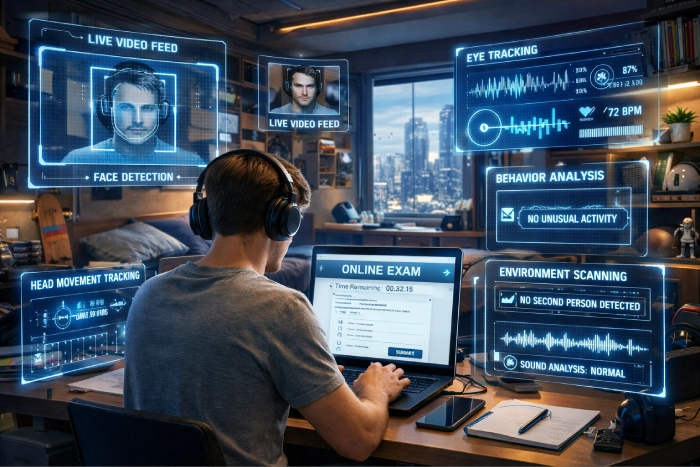
One of the key transformations that will occur in the field of AI is the change in online exams in 2026 in the creation process. The use of artificial intelligence to a great extent facilitates a lot of aspects of the online exam process, from verifying the identity of a student to monitoring the behaviour of a student during the assessment and helping review exam sessions afterwards.
The imaginative future of online exams AI is now a reality. It has become a part of various universities, certification institutions, and professional testing programmes. For further information on the support provided online and guidance for exams, please visit By pass My Exam‘website.
This guide covers the ins and outs of AI proctoring, including some new features that emerged in 2026, and how students can prepare to minimise the risk of getting flagged.
From Human Invigilators to AI-Driven Proctoring
In the old examination halls, all supervision of students was done by human invigilators. This proved problematic as online learning increased, with thousands of candidates from across the country taking exams from various locations.
Most institutions today are employing a mixed monitoring system. AI is constantly monitoring the exam session, and trained reviewers are reviewing any situations that need to be reviewed in greater detail. AI can detect odd occurrences, but most often, other academic choices are made following a human review and not just the software.
How AI Proctoring Actually Works
The AI exam monitoring students’systems used in the process with the modern system of AI goes through several stages, both before and during the exam. Every stage serves to reinforce that the student is taking the test under an approved condition, and it is the correct student who is taking the test.
Identity Verification
Students usually confirm their identity prior to the exam. This can range from uploading an ID document to taking a live photo or a liveness check to ensure that the person in front of the camera is a real person. These checks help to minimise the risk of someone else sitting the examination for a registered candidate.
Environment Scan
The majority of online exams ask students to scan the room before taking the exam.
Students typically walk the webcam across the testing space to capture the information on their desk, environment and any materials nearby. This provides a benchmark that the testing environment fulfils the requirements of the examination.
If there are items in the book, notes, phone, etc. that are not necessary for the scan, they can be taken out before the scan to prevent unnecessary questions at a later time.
Real-Time Monitoring
Throughout the assessment, AI is analysing multiple signals simultaneously. The computer vision technology detects if the student’s face is in view in the camera’s frame. Another function of the system could track the direction of the eyes, the number of times they move away from the screen, or how quickly or suddenly their body direction changes.
Audio monitoring is listening for voices or abnormal noises that may signal for outside help. Certain systems also detect an object that is present during the examination (e.g. mobile phone, prohibited materials). When students grasp how AI detects cheating in online exams, they begin to see that it’s not about individual instances of cheating, but patterns.
Risk Assessment
Many AI systems, instead of taking immediate disciplinary action, will rate a risk score when unusual behaviour occurs.
Instead of automatically labelling a student as “guilty”, the software will take snapshots, video snippets or time stamps of the screen for review later. The flagged events are then reviewed by human reviewers in conjunction with the complete examination context to determine if any academic integrity rules were breached or not.
New AI Capabilities Emerging in 2026
The advancements in AI proctoring in 2026 are centred around enhancing the precision and sensitivity of online exam proctoring.
The one important change is the use of predictive analytics. Some systems can detect patterns that might indicate that the behaviour might be more likely to result in a breach of the rules. Rather than only responding to unusual behaviour, some systems can detect a pattern that may mean that the behaviour is more likely to lead to a breach of the rules. This means that if it is not necessary, it will be possible to add additional monitoring.
One of the other developments that has emerged is adaptive monitoring. Some platforms, instead of observing all students, only boost observing if early warning signs are observed during the exam. This will attempt to avoid the need to monitor students who are abiding by the rules.
The efficacy of AI systems in identifying deepfakes and proxy test-taking is also being enhanced. With the advancement of generative AI, exam providers are also working on further measures to ensure the identification of candidates during the exam.
Why This Matters for Students: Benefits and Concerns?
There are a number of advantages to AI-powered online exams. Pupils may take tests at various sites without having to travel to test centres. The results of institutions can also be processed more efficiently while assuring the consistent monitoring standards for a large number of candidates.
Meanwhile, AI proctoring privacy concerns are an essential talking point of systems. Continuous webcam, microphone and screen monitoring during exams is something that many students are uncomfortable with. Some are concerned that not being abnormal could be seen as weird.
One of the other issues is higher test-day stress. The ability of AI to watch students’ every move can increase some students’ nervousness, especially during a classroom test.
These concerns are well known by most reputable institutions. AI is typically used to flag events to be reviewed for discipline, but it is not the final decision maker. The recordings are usually subject to human review prior to academic action in cases of flags.
How to Prepare for an AI-Proctored Exam
With the help of some simple AI exam tips, your exam session can be a breeze, and you’ll be less stressed.
Before exam day:
- Use the webcam, microphone and Internet connection to test.
- Run all system compatibility tests, if needed.
- Thoroughly read the directions for the exam at your school.
- Select an isolated, private and bright room.
- Clear books, phones and other unauthorised items off your desk.
During the examination:
- Please remain within the webcam’s frame.
- Do not talk or speak to oneself.
- Limit unnecessary movements.
- Make sure that you look at the screen naturally.
- Do all exam providers’ directions.
In addition, it is good to know your institution’s procedures if you encounter difficulties during the examination.
What Happens If You’re Falsely Flagged?
A major issue that comes up with the students is that AI proctoring produces false positives. A false positive is when the normal behaviour is incorrectly classified as suspicious.
Examples may include:
- Giving oneself a break from focusing and thinking.
- Temporary internet interruptions.
- Sounds that cannot be controlled, such as the sound of traffic.
- Movement out of the camera due to an accident.
Luckily, it’s not a rule of being misconducted if they hold a flag. For many online exam systems, each flagged event is looked at by experienced personnel prior to making any decision.
If you think you have been misidentified, let the issuer know that and ask why they’re reviewing you, and if there is supporting evidence. Your institution’s appeal procedure should be followed, and an appropriate answer or explanation given as early as possible.
Conclusion
In 2026, AI proctoring has emerged as a pivotal element in the online exam journey. Although the technology is constantly changing, it is designed to assist in fair and secure evaluations and not to place an unnecessary hurdle for students. To ensure a more confident exam experience, it’s best to familiarise yourself with how AI systems operate, thoroughly prepare your testing environment, and be aware of what you can and cannot do if the exam is flagged. For more help and information on online exams and exam preparation, check out By pass My Exam at
FAQs
Q: Can AI proctoring see everything I do during an online exam?
The AI proctor will be able to look at the information available in your web camera, microphone and screen activity. It doesn’t monitor anything other than what’s in the approved data source, and many systems only examine events that are different from normal behaviour.
Q: Is AI proctoring always accurate?
No. When designing an AI system, you must be aware of the possibility of it interpreting a common action incorrectly, such as allowing a privacy gap when thinking. That’s why it is important to find a provider that is reputable, who will normally need to have it reviewed by humans before making any academic decisions.
Q: What’s new about AI proctoring in 2026 specifically?
Some recent advances are in the area of predictive monitoring, adaptive observation, detection of deepfakes and proxy test-taking, and more context-aware AI systems to assist human reviewers in the decision-making process.
Q: What should I do if I think I’ll be falsely flagged during my exam?
Carefully set up your test area, follow exam guidelines, stay in the camera’s sight and know the appeal process for your institution before the exam.
Q: Do all online exams use AI proctoring now?
No. However, many exam administrations have moved to AI-assisted or hybrid, monitoring both people and computers, to be able to effectively monitor a large number of candidates remotely in many high-stakes examinations.