
How Do Online Exams Work? Complete Guide to Process, Rules & Proctoring Technology
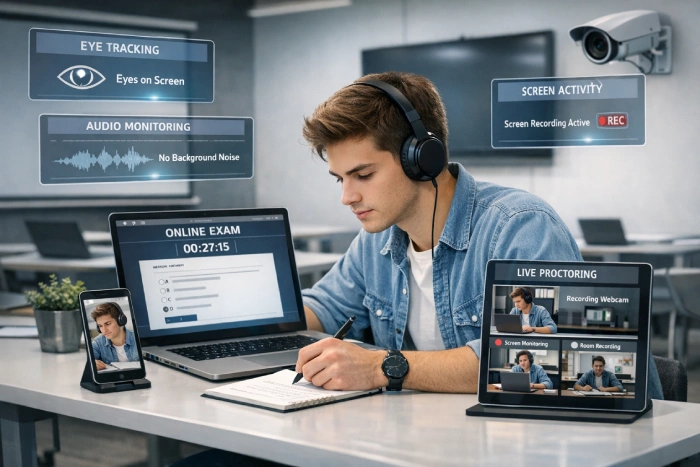
Remote proctoring is a testing model that enables students to complete monitored tests in their own homes with the help of monitoring software rather than a real classroom. Colleges and test issuers have turned to sophisticated software to check identity, track action, and examine behavior when conducting tests. The most common question posed by many students is how online exams work since the experience is quite different from the traditional exam halls. Rather than a teacher strolling in between desks, your computer, camera, and environment are being watched at all times by special programs.
The systems provide a managed digital testing system that prevents cheating and maintains exam integrity. Knowing the process before exam day minimizes anxiety and technical infractions. These platforms are installed by institutions as secure online exam solutions where candidates take tests without necessarily having to visit a test venue, and yet they can satisfy the academic security requirements.
Understanding Remote Proctoring Technology: How It Detects Cheating
Remote proctoring technology has several security layers operating concurrently instead of having one surveillance tool. It is aimed at reproducing supervision similar to a physical testing facility.
- Video & Audio:The video and audio monitoring are the first layer. The microphone picks up background noise around you, and your webcam is capturing your face. When some other individual speaks or comes into the room, this system raises a flag at once.
- Screen Lockdown:The second is the screen lockdown layer. The browser has features that prevent the opening of new tabs, text copying, screenshots, external software, and keyboard shortcuts. Even a warning can be triggered with notification popups.
- AI Analysis:The third level is the analysis of artificial intelligence. Eye-tracking algorithms are algorithms that examine the gaze direction and position of the head to ascertain the focus of attention. Many institutions use these invasive tools to monitor students, raising questions about student privacy in remote proctoring.
This combination will make sure that the remote proctoring technology monitors both digital and physical behavior at the same time.
Human vs. AI: How Does Automated Proctoring Work?
The students tend to mix live monitoring with recorded monitoring, yet they operate differently. Live proctoring entails a human monitor looking over your webcam live. On the likes of ProctorU, proctors can talk to you and pause the exam, and can even control your mouse in case of technical problems. This approach is very similar to a classroom invigilator.
Automated systems do not work similarly. In order to understand how automated proctoring works, the software captures the whole session, and afterwards, the Artificial Intelligence is used to scan the session and identify any suspicious behavior. Risk scores are given to movements, voices, changes in lighting, and atypical changes in the screens. Segments flagged are later reviewed by the instructors.
The two approaches are used to ensure integrity in exams, though automated monitoring is more suitable for big universities, whereas live monitoring is more effective in providing immediate action.
The Step-by-Step Online Exam Process
Online tests are conducted in a structured manner. Being aware of the stages helps students to get prepared well and meet the proctored exam requirements.
System Check
Before the exam begins, you must run a system diagnostic to ensure your computer meets the technical equipment requirements needed to support the software. This is a camera, microphone, internet, and browser check.
ID Verification
To the camera, you have a government identification card. The system would take your picture and compare it with the registration.
Environment Scan
You use the webcam to turn around to reveal what is around you.
Exam Launch
The secure browser is enabled, and it locks your computer until it is submitted.
The Online Exam Room Scan Requirement
The online exam room scan would need a complete view of the testing environment. You need to demonstrate the 4 walls, the desk, and the space below the desk. Some sites require a mirror to ensure that nothing is attached to the monitor. The online exam room scan is guaranteed to keep no hidden notes, devices, or people in the room before the start of the timer.
Critical Online Exam Rules and Regulations
The online exam rules and regulations are not as liberal as most students anticipate. The breaches are unintentional and usually committed.
- There is no talking, not even reading out loud. The speech is deciphered by the microphone as potential cooperation.
- Eye movement matters. Anything more than a few seconds of looking away from the screen can provoke suspicion.
- Your table is to be kept absolutely clean. Cell phones, wrist watches, papers, or headphones are prohibited unless explicitly authorized.
- It is generally prohibited to move out of the camera view. The attempt may end with bathroom breaks or door answers.
When online exam rules and regulations are taken into account in advance, this will avoid the automatic invalidation of scores.
Popular Exam Monitoring Software Platforms
The various exam monitoring software is adopted by different institutions; however, most of them are categorized into recognizable classes.
- Pearson OnVUE offers high security monitoring that is applied in professional certifications. It stresses tight identity validation and environment validation.
- ProctorU has human supervisors who interact with candidates in real-time and help set up.
- Universities are known to use Respondus Lockdown Browser. It blocks computer usage but captures the webcam images to be reviewed later.
The awareness of the exam monitoring software encourages the students to be ready for the type of monitoring they are going to receive.
Technical Troubleshooting (What if the Internet Fails?)
The frequent issue is connectivity issues. Luckily, the answers on most platforms are saved automatically as one writes instead of at the time of submission. In case the connection goes dead, you normally reconnect and go back to where you left off before the interruption.
A key part of understanding how online exams work is knowing the disaster protocols that have been incorporated into systems. Proctors are in a position to detect disconnections with the help of logs and re-establish the sessions when needed.
A wireless network can be minimized with the help of an Ethernet cable. Background application closure will also stop crashes and increase the stability of the software during testing.
Planning reduces technical hitches more than re-troubleshooting later.
Conclusion
Online exams are convenient and work under very controlled conditions. In the combination of cameras, locked browsers, artificial intelligence, and strict behavior rules, academic integrity is ensured. They are given flags even without cheating by students who approach them casually. Set up the environment, expectancies of software, and instructions are to be followed to the letter to be successful. When the learners have a clear idea about How online exams work, they will go to testing without panic rather than being taken by surprise by the restrictions involved. It is a process that does not emphasize solely memorization but preparation and awareness. In case you are not completely sure of what is needed and how things are organized, you can contact our team and discuss your questions before your set assessment and prevent expensive errors during the exam day.